.png)
Homelessness in Central Oregon: From secure home to homelessness, a common pattern

As our project winds down, we share our findings about what drives homelessness, the people living it, and the solutions within reach

By DAVID DUDLEY
The Homelessness: Real Stories, Real Solutions journalism lab staff has spent the past 18 months searching the streets, shelters and remote encampments for people willing to share their stories of what it means to be homeless, and the challenges that come with it.
We met Lucy Wolfe, a member of the Confederated Tribes of Warm Springs. She lived on the streets for nearly two decades before finding a home. Today, she makes traditional jewelry and dreamcatchers in her kitchen.
Mark Jenkins lived in the China Hat woods for two years before a service provider helped him land an apartment at Cleveland Commons, the first permanent supportive housing project east of the Cascades.
And Sam Adams, who was diagnosed with Huntington's disease in 2012, cycled through shelters before finding a stable room at the Franklin Avenue Shelter, run by Shepherd's House Ministries.
Our search yielded 31 stories in all. Taken together, they reveal a detailed, often devastating panorama of homelessness in Central Oregon. But there were moments of light, too.
What follows is a synthesis of what we found: the forces driving homelessness, the people living it, those who are trying to help — and solutions that have the power to change lives.
People we met, problems they faced
We strived to center the people living a harsh reality that many never experience. In story after story, a pattern emerged: Almost all of them once lived comfortably in homes they believed to be secure.
Then, an unexpected bill, injury, illness, divorce or death pushed them over the edge. While there are many factors driving homelessness the number one issue we identified was access to affordable housing, but poverty and the growing gap between wages and costs are also pushing record numbers of people into the streets.
Phil and Megan Gordon worked fulltime. But the cost of living in Bend quickly outpaced their stagnant wages. The Gordons' gradual slide into homelessness unfolded across two decades.
The Gordons were pushed out of a succession of rentals before buying and living in an RV. When a neighbor threatened to shoot them for parking their RV beside a relative's house, they began spending their days moving between parks.

Pastor Dean "Dino" Antonucci suffers from Crohn's disease. Like the Gordons, the Antonuccis were pushed into an RV by Central Oregon's housing costs.
But the Antonuccis also contend with crushing medical debt, which can create a cycle that is almost impossible to escape: Illness drives debt, debt leads to rejection by landlords, rejection feeds homelessness, and homelessness leads to avoidable illness.
Some health conditions incur expenses daily. Andrew Couture, a decorated Marine Corps veteran, has lived in the juniper forest east of Redmond for more than a decade.
Couture runs an oxygen machine off a generator, spending $600 a month on fuel just to stay alive.
"If that goes, I go," he said. His monthly pension is $1,400.
Damari Perreard, 57, worked for four-and-a-half years at Shepherd's House Ministries, where she advocated for people experiencing homelessness. After battling an undiagnosed illness, she collapsed in her driveway — sustaining broken ribs, a fractured skull, and a ruptured eardrum.
When we met, she was facing eviction from the townhome she called home for seven years. She had no job, so no income.
"I spent my life fighting for those in need," she said. "Now that I'm in need, I wonder who will fight for me?"
While the challenges are significant for the people we met, and countless others across the U.S., there are several viable solutions at our disposal.
Solutions within reach
We set out to document the factors driving homelessness — access to affordable housing, lack of resources and chronic health issues — but our reporting was not designed to end in despair. Solutions, proven and proposed, appear throughout the stories.
Housing paired with services is the most effective solution available. There are several models, ranging from short-term emergency shelters to long-term, permanent supportive housing.
The Franklin Avenue Shelter, run by Shepherd's House, shows what happens when housing, case management and medical care combine to create a path forward.
Sam Adams acquired access to physical therapy, nursing and palliative care at the Franklin Avenue Shelter before moving on to Cleveland Commons.
Adams's neighbor, Trevor Duncan, was misdiagnosed with Lou Gehrig's disease before learning he'd had a stroke. Duncan found stability while living at Franklin Avenue. Then, he saved enough money for a security deposit to move to Cleveland Commons.
Now, he and Adams have access to physical therapy and in-home nurse visits.

Todd Walters, 60, served 18 years in the Marine Corps, including Desert Storm. Walters was living with a friend in Redmond. Walters became homeless after his friend died of a stroke. Walters parked in the Walmart lot in Redmond before seeking shelter at The Lighthouse Navigation Center, also run by Shepherd's House.
Cait Darrah, a caseworker at the Lighthouse, helped Walters get back to California. After reading our story on Walters, Darrah was assisted by a group of anonymous donors who helped repair and register Walters's truck. They also bought enough gas to get him and his dog back to Lodi.
The Antonuccis were given a space to park their RV through Mountain View Community Development's safe parking program in Redmond.
"We were coming down to the wire," Antonucci said, "and had no other option available to us. We're grateful to be able to park there."
In response to our reporting, an anonymous donor provided funds to help Antonucci and his family repair the heater in their RV.

Central Oregon Villages operates 32 units of emergency outdoor shelter and safe parking in Bend, including the new Franklin Avenue family cabins.
Trish Gaut, 57, spent five years living in the La Pine woods with her teenage grandson. They moved into one of four tiny homes situated at the corner of Franklin Avenue and Fifth Street. They recently moved on to an apartment of their own.
"I'm still in shock," Gaut told FORJournalism. "For the first time in his life, my grandson has his own bedroom."
These models help people navigate the path from unhoused to housed. While critics say they're too costly for taxpayers, the data shows that it's more affordable to house people than to fund services for unhoused people.

Build more housing
A report by the National Low Income Housing Coalition found that Oregon needs to add 110,000 affordable rentals across the state to prevent more people from falling into homelessness. The city of Redmond has added only 145 affordable units toward a target of 2,288.
Northpoint Vista in Redmond would add roughly 447 units of affordable, workforce and market-rate housing, but the project was hamstrung by a state rule that requires a majority of the affordable units to be finished before market-rate units can be built.
That undercuts efforts to build affordable units for low-income people, as well as delaying market-rate units, which will lower overall housing costs in the long run.
Following our reporting, state regulators approved the city of Redmond's rule change request that allows the project to move forward.
A mailing address
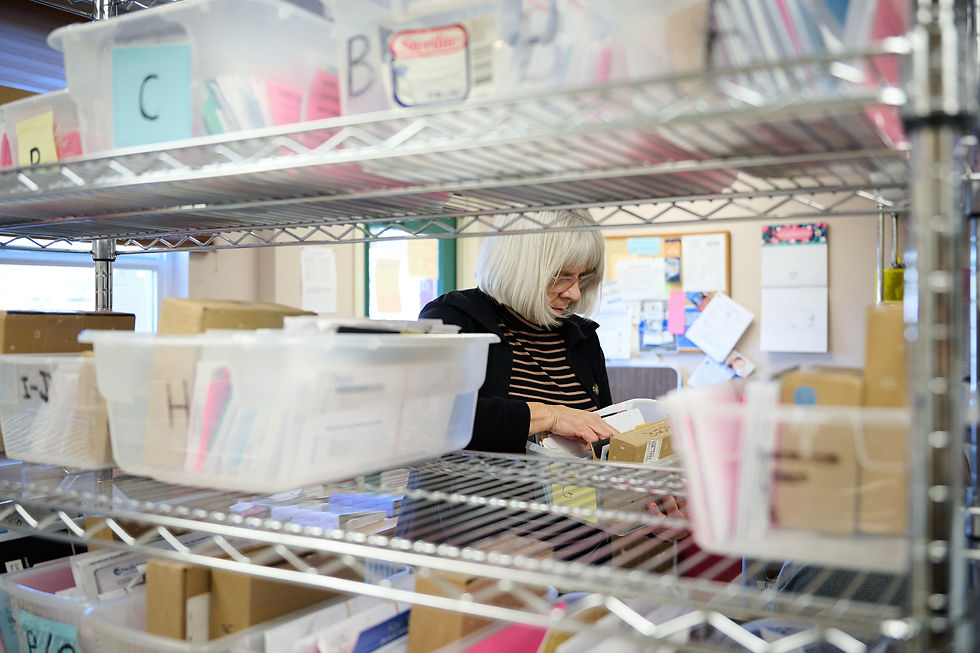
The mail program at Bend United Methodist Church provides a postal address for more than 200 people. The service gives them a way to receive Social Security correspondence, assistance documents, packages from family and everything else that requires a permanent address. Participants can vote, list the address on job applications and receive their driver's licenses.
"If you give them an address, and a place where they can pick up their mail, they can help themselves," said volunteer Cindy Pierce.
Peer support
Research shows that people wrestling with substance use disorder who receive peer support are 35% less likely to relapse.
J.R. Montgomery's story illustrated the informal version at work. Montgomery spends his days volunteering, donating and checking on friends who are struggling.
When we met, one of Montgomery's friends was rumored to have relapsed. Montgomery became visibly distraught, then set out to find his friend.
Montgomery eventually found his friend and helped get him into rehab.

While living at The Lighthouse, Walters rolled his grill onto the sidewalk every other day to cook burgers and chicken for anyone who was hungry.
"Sharing food with each other reminds us that we're human," Walters said.
Couture's friend and former neighbor Patricia Griffith was homeless for more than 20 years. Griffith, 60, faced several barriers to acquiring long-term housing: She had a felony on her record, she lives with a lively medium-sized dog, and she's a transgender person. She lived in a cabin at Oasis Village until she secured a mobile home in Deschutes County.
Once Patricia Griffith got settled into her new home, she invited one of her formerly homeless friends to join her.
These examples show that, when people help people on a small scale, communities grow stronger.
Collaborative service
The China Hat sweep displaced more than 400 unhoused people who had camped in the forest. Despite the hardships that came from the largest encampment sweep of its kind, the event showed that coordinated efforts between service providers and government agencies can effectively reduce harm for those who will be impacted.
Several agencies and service providers helped campers like Penny Gartner and Steven Putnam get into Cleveland Commons apartments, where they joined Jenkins, Adams and Duncan.
Retired attorney Chuck Hemingway spearheaded a lawsuit to buy more time for campers before they were compelled to move.
Tim Ellis and Lynd Wieman drove Shepherd House's SHARE van to the area weekly to provide campers with food, clothing and other items they needed to survive while preparing for the looming sweep. They also offered advice on how to survive the sweep.

Mandy Bryant and Chris Daggett met while camping at China Hat. They fell in love and now share an RV. They spent countless hours helping their neighbors pack, clean and tow their vehicles and camper trailers out of the area.
Jessica Gamble lived with her partner and two young children in the China Hat woods. She used that experience to found the Home More Network, a nonprofit that helps people navigate the labyrinth of housing assistance.
"There were no arrests, no violence," she said. "It's a testament to what's possible when we work together."
Candles burning in the night
The people we met lived full lives as artists, soldiers, parents, musicians, children who dreamed of becoming nurses or lawyers. They're more than statistics and cautionary tales; they're members of the community. They've faced hardships that many of us never imagine.
Many of the people in our stories are still here, but nobody can say for how long. A 2024 Health Affairs study found that unhoused people have a life expectancy of 43 to 45 years.
Beth Beauregard spent more than a decade living unhoused between Bend and Redmond. Her sister, Wendy Brown, a nurse in New Hampshire, said Beauregard had changed after an auto accident killed her 14-month-old son.
Beauregard refused help. She battled diabetes without medication. She died of a heart attack at 64 last October. Beauregard was one of the 499 Oregonians who died last year while homeless, a reminder that homelessness is a death sentence.
Family, friends and service providers gather each year on the winter solstice to light candles for those who died during the previous year. There were 29 candles burning at the Longest Night vigil at the Bethlehem Inn, Redmond. One of those candles commemorated Beauregard's life.
"Each year, the list grows," said Michael Hancock, executive director of Bethlehem Inn. "We honor those who died, but we're also pointing to the people who are still alive, still struggling. They need help now, so they don't end up on the list."
Homelessness: Real Stories, Real Solutions (realstoriesrealsolutions.org) is a journalism lab funded by Central Oregon Health Council under FORJournalism (forjournalism.org), an Oregon nonprofit dedicated to supporting journalism statewide. Sign up for weekly newsletters to receive updates.


Comments