.png)
'We thought we were safe': The story of a Bend family's fall into homelessness

Before the pandemic, Phil and Megan Gordon were happy to be in Bend. They had jobs, they launched a business, and they were close to their kids. But amid the pandemic housing crunch and the cost-of-living crisis, they were forced out of a house and into a hotel. Then, when they moved into an RV, they found that even asking for help has a price.

By DAVID DUDLEY
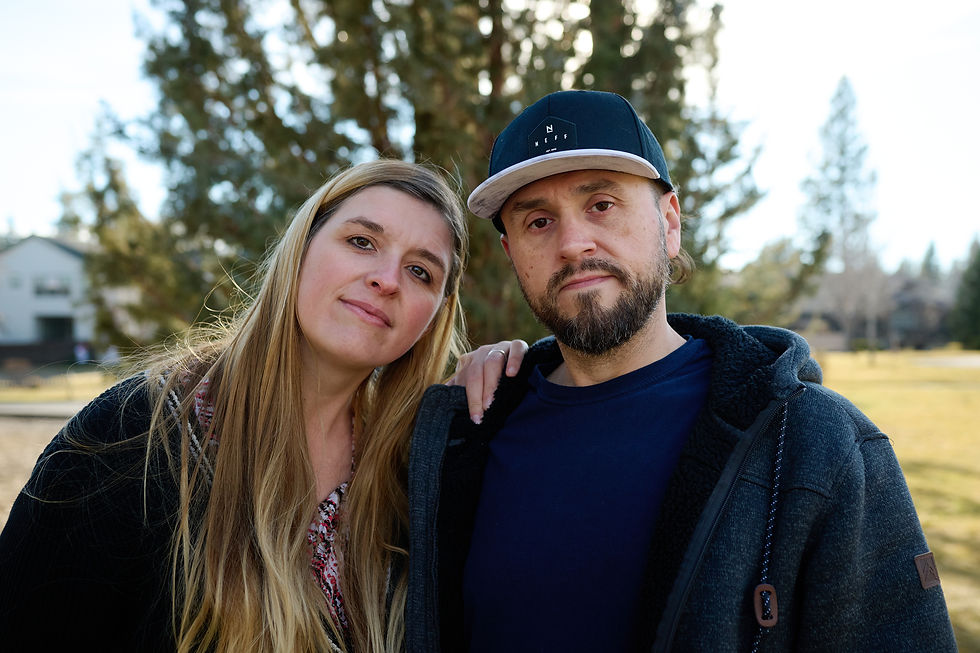
Phil Gordon and his wife, Megan, bought an RV a little more than a year ago. The RV wasn't for recreation purposes—it would be their new home.
They'd slept for a year in their SUV by then. They needed more space to stretch out than a Saturn Outlook could offer. They also needed a home that wasn't so vulnerable to the volatile dynamics of the Bend housing market.
"We couldn't afford anything else," Gordon, 45, said. "And it's only getting worse. So, we bought an RV."
With that move, the Gordons joined nearly half-a-million people who have traded life in a traditional home to live in an RV. While some retirees choose RV life for its relatively low costs and flexibility, the number of Americans living in their vehicles because they can't afford housing has nearly doubled since 2021.
However, finding safe places to park is an ongoing challenge. The Gordons were grateful when a family member agreed to let them park beside a home in Bend. They were happy to have electricity to run a small space heater, access to a shower. And, more importantly, they were happy to be near their two youngest kids, aged 16 and 13, respectively, who moved into the relative's house when the Gordons became homeless.
"When we parked the RV beside the house, the neighbors seemed to be okay with it," Gordon said. Then, something shifted. "A belligerent neighbor approached us one night. He said if we didn't leave, he was going to call the cops."
The Gordons were at a loss. They needed that space, but they didn't want to cause problems for their family or get into legal trouble themselves. So, they left.
"What else could we do?" Gordon asked.
Suicidal empathy
That event may offer a glimpse into one of the ways America has changed in recent years.
The cost of living continues to rise, pushing rents and home values sky-high. A recent Bankrate study found that 75% of homes across the nation are unaffordable. That, in turn, has driven record-breaking numbers of people into the streets.
The two most recent national Point-In-Time counts showed that 653,104 people were homeless on a single night in 2023. That number jumped to 771,480 in 2024. The number of homeless people in Central Oregon has increased by 89% since the pandemic, and it shows no sign of slowing.
The trend suggests a growing systemic problem that will require a concerted effort by lawmakers, law enforcement, business people, health care professionals, social workers, service providers and their broader communities. But polarization in America means solutions are becoming harder to agree upon, because public perception of homeless people has shifted.
Whereas empathy for the impoverished once encouraged people to help those who were less fortunate, conservative influencers like Elon Musk have begun to question the virtues of empathy.
"Suicidal empathy is killing Western Civilization," Musk wrote in a recent X post.
Then, in an interview with Joe Rogan, Musk clarified that he doesn't think empathy is bad, per se, but he claimed it has been "weaponized."
“The fundamental weakness of Western civilization is empathy, the empathy exploit,” Musk said. “They’re exploiting a bug in Western civilization, which is the empathy response.”
Canadian evolutionary scientist Gad Saad coined the term, and conservative Christians like Joe Rigney and Allie Beth Stuckey have since taken up the fight against loving thy neighbor. Especially if said neighbor is impoverished, an immigrant, or someone who votes for the other party.
That fighting spirit has fueled President Donald Trump's policy toward homeless people during his second term. Trump criminalized homelessness with Ending Crime and Disorder on America's Streets, an executive order filed in July.
The order paves the way to restore civil commitment, which enables law enforcement officers and health care providers to forcibly institutionalize those who are wrestling with chronic homelessness and other health crises, like addiction.
One institution meant to serve that purpose is already taking shape on the outskirts of Salt Lake City, Utah. Supporters say that it will save lives, but critics worry that the remote 16-acre campus that will house up to 1,300 people resembles a detention camp more than a health care facility.
At the same time, the Trump administration, led by Musk's now defunct Department of Government Efficiency (DOGE), has cut millions of dollars in funding for the U.S. Department of Housing and Urban Development (HUD). Administration officials have also proposed several rule changes — including two-year time limits and work requirements — for those who receive housing assistance.
Those developments prompted Oregon Attorney General Dan Rayfield, along with a coalition of 20 other states' attorneys general, to sue the Trump administration for "illegally upending supports for tens of thousands of Americans experiencing homelessness or housing insecurity."
The Gordons are just two among thousands of Oregonians who have been pushed into homelessness by rising housing costs.
Rent keeps rising
Bend wasn't always so unaffordable. Gordon said he lived with his wife at the time, the mother of his three kids, in an apartment situated along the Deschutes River in 2001.
"We paid $540 a month," he said. "Everything was included. Utilities, cable, you name it."
It was a one-bedroom apartment, but it was home for Gordon's growing family. That was nearly 20 years before the COVID pandemic turned the world upside down. As Gordon and his wife welcomed more children into the world, they needed more space. They eventually rented a three-bedroom house — for $760 a month.
Then came the 2008 housing crash. In the economic chaos that followed, known as the Great Recession, the worst financial crisis since the Great Depression, their landlord raised the rent to $1,000, a 25% spike.
"It happened overnight," Gordon said. "It pushed us to the edge, but we didn't have any alternative. We did what we had to do."
The landlord raised the rent to $1,600 three years later. Gordon said he and his wife lived in that house for 10 years. Their kids — who are now 20, 16 and 13, respectively — grew up there.
That was in 2019. Though housing prices were surging, Gordon said he was prepared to keep paying the rent.
"We didn't have anywhere else to go," Gordon said. "Then, our landlord pushed us out so she could sell the house. We'd been there for 10 years, so we didn't know how much the market had changed."
'We thought we were safe'
Big changes were brewing in Bend, but the housing market hadn't exploded — yet.
Gordon and the mother of his children divorced. Then, Gordon met Megan, 37. She moved in with Gordon and his kids.

Megan worked at Pier One. A co-worker put a handwritten note on the bulletin board in the breakroom. The note read "House for rent."
The process to get into that home was much easier than it is today. Megan's co-worker didn't require the Gordons to make three times the monthly rent, which the woman had set at $1,900. Megan said their new landlord seemed happy to have a family move into the home.
"She told us that Phil's kids would graduate from high school while we lived in that house," Megan recalled. "Those were her exact words. Though she intended to let her daughter live there some day, she told us we could stay there indefinitely."
Megan believed her co-worker meant it at the time.
COVID hit a few months later. As work-from-home policies were implemented across the country, millions of workers were suddenly free to move wherever they wished.
President Trump declared the COVID-19 outbreak a national emergency on March 13, 2020. Oregon Gov. Kate Brown imposed a temporary moratorium on evictions in Oregon on March 22, 2020.
"We thought we were safe," Gordon said. "We thought we wouldn't be evicted, because of the moratorium."
"Wrong," Megan cut in. "Our landlord gave us notice that she wanted us to move. Which is exactly what we didn't need, because nobody was showing homes in person."
The Gordons wanted to fight the eviction, but Megan said their confidence waned when their landlord hired a lawyer. The Gordons couldn't afford rent, so hiring an attorney to protect their interests wasn't feasible.
It was also harder to hunt for a new home, due to rapidly shifting pandemic restrictions like mask mandates and social distancing advisories.
"We tried to find another place," said Gordon. "We put on masks and booties. We saw homes. We stayed 8 feet away from property owners and managers."
Though the situation looked grim, Gordon said they remained hopeful. After all, they're both Bend locals.

"We thought the local property owners would want to help out local workers," Gordon explained.
Wrong again.
As tens-of-thousands of people moved from places like San Francisco, Seattle and Portland, the Bend housing market created opportunities for sellers to turn large profits on properties that saw significant drops in value just a decade earlier.
Bidding wars ensued as droves of would-be buyers were forced to rent by the dwindling housing supply. That drove up rental prices, and those relying upon Bend wages found themselves priced out of the market.
Some long-time Bend residents moved to places that were less expensive, less competitive, during the tumult. But Gordon made the difficult decision to stay.
"We would have left, were it not for our kids," Gordon said. "I need to be near my kids. I want them to graduate with their friends, and in their hometown."
Driven by desperation
The Gordons spent eight months fighting the eviction. At the same time, they searched for a new home, so they wouldn't find themselves on the streets.
"It was extremely stressful," said Megan. "Process servers would pound on our door, and we'd find papers taped to it. The last three months there were brutal. It was literally tearing our family apart."
Faced with the same challenges, Gordon's 75-year-old mom had moved into the Gordons' home, which meant that three generations of his family faced homelessness. That didn't stop the situation from escalating yet again. They were served with a final warning.
"We needed to be out within 30 days, or we would be removed by the police," Megan said.
"I pleaded with our landlord to let us stay," Gordon said. "She said, 'Don't talk to me about this, talk to your senator in Salem.'
"We were running out of options," Gordon added after a pause. "So, we dipped into our life savings to stay in a hotel. It was that or live in the streets."
Gordon said they lived in a suite of hotel rooms for nearly a year, which depleted their savings. Then, while surfing Facebook marketplace one day, Gordon glimpsed light at the end of the tunnel.
"It was a townhouse," he said. "The owner was getting all these nasty comments from local people who said $3,000 a month was too much, it would never rent."
But the Gordons were desperate, and the woman's asking price was roughly the same as what they were paying to live in the hotel. So, Gordon messaged the woman.
"I told her that we would do it," Gordon said. "She asked if we had the $7,000 required to move in. We moved in shortly after that."
'Who makes that much?'
Gordon said he was happy to finally have a home again after living in a hotel for so long. Then, the reality of the spiraling cost-of-living crisis became clearer.
"We weren't even living check to check," Gordon said. "We were living in the red every month. We were pinching every penny, but we were being gouged."
With nowhere else to go, Gordon accepted the gouging. Then, in 2023, Gordon said the woman decided to sell the property while the market was at its peak.
Blindsided again, the Gordons were back to square one. But this time, they had only 30 days to find another home.
Gordon, who belongs to the sandwich generation — a group of adults who are simultaneously caregivers to their children and their parents — said his mom moved to a shelter for the homeless. His kids went to live with his ex-wife, while he and Megan moved into their Saturn Outlook.

Living in the SUV was hard, Gordon said. But he wasn't prepared for the way his relationships with family and friends would shift.
"They assumed that we didn't have jobs, because we were living in our vehicle," he said. "But we were working. We just couldn't afford to live here anymore."
While living in the hotel, Gordon and Megan began delivering papers in Redmond to save money for their next move. Additionally, Gordon runs a reselling business on eBay. He specializes in vintage toys, board games, video games and consoles.
"It's steady," he said, "but we don't make three times the rent, because it's so high. At $3,000 a month, you have to earn $9,000. Who makes that much?"
A new normal
The Gordons delivered papers for a year, but the odd hours — they went to work at midnight, and returned home after all their papers had been delivered — meant they didn't see their kids.
Then, Megan landed a job at a Hanes outlet store in Bend. She said the pay was steady, and the hours allowed them to spend more time at home. She thought things were improving when she was promoted to assistant manager in July of 2023, but the store abruptly shuttered in August, not even a full month after she was promoted.
That kind of precarity is part of a trend that has emerged since the coronavirus pandemic, according to journalist Brian Goldstone, author of “There Is No Place for Us: Working and Homeless in America.”
In the book, Goldstone says that millions of Americans who are working full-time jobs, or multiple part-time jobs, can no longer afford housing in the U.S.
"A low wage job, really, is homelessness waiting to happen," Goldstone said in a recent PBS interview. "It's not just that their wages are too low to keep up with the skyrocketing cost of having a place to live, it's also that the jobs themselves have become increasingly volatile and precarious."
As gigs replace full-time jobs that once came with benefits and the promise of a pension, today's workers often don't know how many hours they'll get from one week to the next, Goldstone said, because employers are always seeking ways to cut costs.
"Their employers give them 29 hours a week instead of 30," Goldstone explained, "because at 30 hours, they would be eligible for basic benefits like health insurance or sick leave."
Go live in the woods
The Gordons have lived the struggle Goldstone described. They've been homeless for roughly two years. With no viable, immediate way to change their situation, they bought an RV one year ago. Though it's old, Gordon said, it's an upgrade compared to the cramped Saturn.
"We parked it at a relative's house, where our kids live," Gordon said. "We were able to plug in there, so we ran a small heater."
That's how the Gordons made it through the winter, but some of the neighbors began paying close attention to the RV as spring set in. Then, as the Gordons tell it, a neighbor who once seemed supportive began to act differently.
Gordon called the neighbor "Garage Guy." Gordon said the man, a newcomer to the area, spent much of his time puttering in his garage and driveway. They didn't know it, but he was watching them.
"At first, we would talk, he was friendly," Gordon said. "He said he understood our situation, because of the cost of living. He said that some of the other neighbors were concerned, but he told them to leave us alone."
One night, around 10:30, they heard a man yelling outside the RV — and he was getting closer.
"Our youngest son said goodnight to us," Gordon said. "As he was going back into the house, a man had approached him and started yelling. So, I went out to see what was happening."
Gordon said he found Garage Guy yelling at his son.
"I asked him what was going on," Gordon said, "and he started yelling at me. He's telling us to get out, to get our kids in the RV and just go away, live in the woods, whatever. He threatened to shoot us."
"I'm still upset that he's willing to tear apart our family, just so he won't have to look at our RV," Megan said. "I get that you don't want a tent city in the neighborhood, but we're just parked along a fence in our family's yard. We're not doing drugs or getting drunk. We don't cause any trouble."
Crosses in the frost
That event rattled the Gordons, so they started spending more time in parks during the day. They were always on the lookout for sparsely populated areas where they could park and spend the night.
"We'd leave early in the morning, just to make sure we weren't upsetting anybody," Gordon said. "It's not sustainable, but that's what we're doing. I'm at a loss, because I just want to be close to our kids."
The Gordons said they'd reached out to several church groups for assistance.
"They weren't as welcoming as we'd hoped," said Gordon. "We would go in, tell them our story, and they might feed us, or offer to spend time with us.
"But then, this attitude would reveal itself," Gordon continued. "They thought we deserved to be homeless. They deserved what they had, so we deserved what we've got."
As the 2025 holiday season was in full swing, the Gordons woke each morning to find frost on their RV's windows. They didn't have access to electricity, so they couldn't run a small space heater.
"Last winter, I was drawing crosses in the frost to keep myself entertained," said Megan.
The Gordons are seeking a home, but several hurdles stand in their way:
They don't make three times the monthly rent.
Because rents remain stubbornly high, they haven't been able to save enough to cover move-in costs, which often include first and last month's rent, in addition to a security deposit.
They have an eviction on their record.
And then, there's the public perception of homelessness, which makes asking for help that much harder.
"People think that, because we live in our RV, we must be drug addicts," Gordon said. "They think we don't want to work, that there's something wrong with us, so we deserve this."
"But we're just trying to survive," said Megan. "At this point, we'd be happy just to have a place to park where we can access electricity and water."
Homelessness: Real Stories, Real Solutions (realstoriesrealsolutions.org) is a journalism lab funded by Central Oregon Health Council under FORJournalism (forjournalism.org), an Oregon nonprofit dedicated to supporting journalism statewide. Sign up for weekly newsletters to receive updates.


Comments